Sunday, July 2, 2017

part 2: Taormina et al.

Believe it or don't, that last post covered about a day and a half of our nine-day sojourn to Sicily. We really are not relaxed travelers--we need to see and do and eat everything, all the time!--which explains why I usually need a vacation from our vacations when we return home afterwards (meaning about a week to recover). But enough about home--back to Sicily!

We arrived in Taormina mid-afternoon on Sunday, parked at our beautiful hotel (wherein we were on the 4th floor--5th, for my American readers--with no lift. Shut up, knees! You're not the boss of me!), and headed immediately to Taormina's main attraction, the 3rd-century BC Greek amphitheater.

First living creature we met upon arrival at our hotel. Cat sleeping on the printer = we've come to the right place. (As one would suspect, as a hotel cat, he was quite sociable, when he wasn't napping.)

View from the amphitheater over the city.

The amphitheater itself! Which is still used for events and concerts.

From the other angle, with Taormina in the background.

Ugh, we all know how much I love me some ancient script. Here, a 1st- or 2nd-century BC financial account in tiny, tiny Greek lettering (inside the small-but-rich museum next to the amphitheater).

And here, my dear husband being super helpful as I try to take photos. This is what I have to deal with when I travel, folks. (He's like the Stewie-cat of people.)

After descending from the theater, we headed into the tiny city center to see what was what. Stumbled across the 10th- through 15th-century Palazzo Corvaja, which contains, among other things, the tourist info office...

...and this rather fascinating augmented-reality presentation on the UNESCO sites in Sicily. (I thought the info was quite interesting; Mike was excited about the headset.)

Taormina is a gem. No wonder it's packed with people like us, craning our necks in every direction.

On the lovely Piazza IX Aprile.

Etna, always. (From Piazza IX Aprile.)

View from our room after dark.

Dinner was at the charmingly-hidden Vicolo Stretto ("narrow alley"--and very aptly named, as the alley in which their entrance is located was so narrow that Mike had to turn entirely sideways at first, hah!), where we shared starters of ceviche made with local shrimp and accompanied by lime granita; caponata; and grilled local prawns with mozzarella and artichokes. 

Table full o' starters. Look how pretty! (Very tasty, too.)

Mike went for paccheri pasta with mussels and zucchini for his main, and I opted for a bowl of lentil soup with veggies, greens, and homemade croutons, and then I went with the cassata for dessert, and he had the "reimagined tiramisu," made with orange peel, fried doughnutty pieces, and pine nuts. (Followed by some excellent espresso, as we do.) Quite a nice casual meal, I thought, plus this:

The actual vicolo stretto leading to the restaurant. Very atmospheric.

The next morning, we decided to head up the mountain to the tiny town of Castelmola, which is crowned by a castle ruin. 

Don't kid yourself, that place is high up the mountain. This is view towards the mainland from Castelmola.

View from the castle down to Taormina's (with the Greek theater on the left).
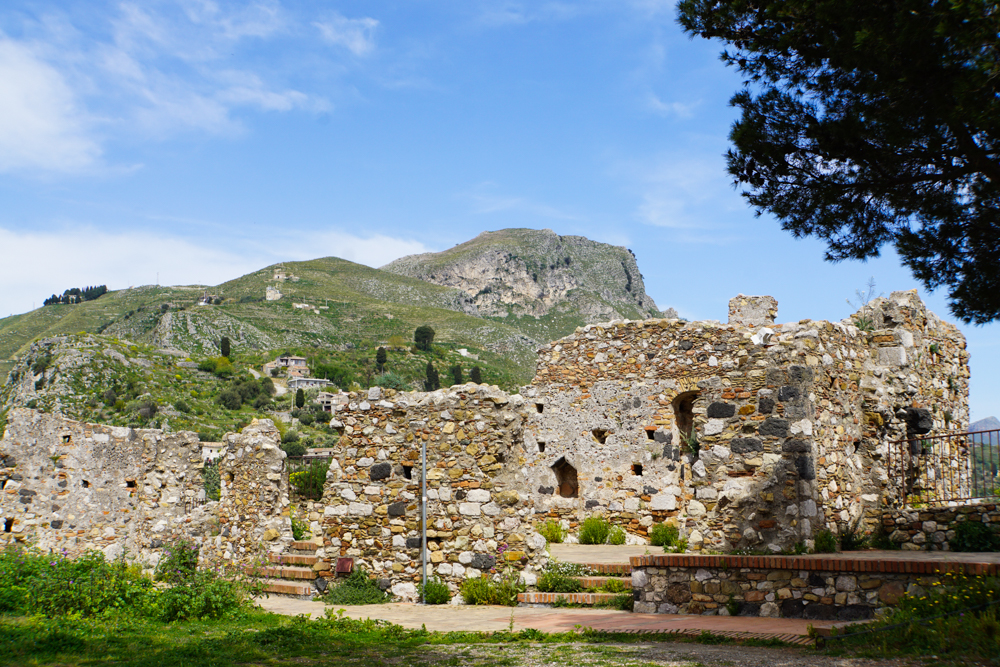
Oh, Castelmola, your castle really is just a ruin. Sigh. But at least your views are nice.

Next to the castle ruins there was a small museum containing several Catanese marionettes, which evolved into their current form in the 19th century, although the tradition of puppet theater in Sicily dates back to the 15th. These things are massive, standing around 110 cm tall, and can weigh in at 30 kg (43 inches tall, and 65 lbs!). The shows performed with said puppets consist of a loose combination of local history, folklore, and medieval legend (most commonly, stories of the Norman conquest of the island), and the "Opera dei Pupi," or Sicilian puppet theater, is now on UNESCO's list of Intangible Cultural Heritage. (Fascinating. And let me tell you, they spared no expense on the details on these things, the fabrics and the armor decoration and whatnot. They're ornate.)

Back down in Castelmola, one finds the arco antico, part of a city wall from the 900s...

...and a whole lot of charm. The place is filthy with it.

Headed back down the hill to check out the tiny little church of Madonna della Rocca, which is built into a grotto in the mountainside. (Crazily enough, there are stairs up to this place from Taormina, but we went by car, because that climb would be insane.)

Super clear view of Etna from Madonna della Roca.

Terracing everywhere, even on these steep, steep slopes. No idea why--wine? Other growy things? Or just trying to keep the hillside from sliding down on top of everyone? Either way, steep and terracey.

Back down in Taormina, we found our way to the Naumachie, the remnants of an absolutely massive supporting wall for a cistern that the Romans built in the 1st century (...maybe) on top of preexisting Greek foundations. (The name means "sea battle," because the area of the cistern is so big that its 18th-century "discoverer" assumed that the Romans had held naval games here.)

This thing is about 130 meters (430 feet) long, and, seeing as how it's smack in the middle of town, has newer shops and apartments built on top of it.

Did I mention how pretty Taormina is??

And then we stumbled across this tiny studio where this man was hand-painting the most exquisite designs on plates (a custom order! I want a custom order from Signore Mirisciotti!), and where I spent a near-exorbitant amount of money on an incredibly beautiful bowl of my own. (After much debate and agonizing. With myself.)*

While I was agonizing, we made our way to the gardens of Villa Comunale, where they have, among other things, several very magnificent cacti;

a couple of reindeer (...?) topiaries;

this manned "Pig" torpedo from WWII;**

a killer view;

and these utterly bizarre little buildings called "Beehives," or "Victorian Follies," constructed according to the designs of one Lady Florence Trevelyan (Queen Victoria's cousin, who'd moved to Sicily and married Taormina's mayor) in the 1890s. 

All of the materials are local, with some bits being salvaged pieces of Greek and Roman architecture, and they're supposed to (obviously loosely) mimic pagodas...

...but it all felt very Swiss Family Robinson-y to me.

See? (On the one hand, it's a bit sad that these things are closed to the public, but I'm sure that's for the best, as they all looked straight-up rickety.)

Ohhh, and don't think you're getting away with just one church visit in this post! On our way to dinner, we wandered past the duomo, built and re-built between the 13th and 16th centuries. We ducked inside, although we didn't stay long, as they were about to have a service. 

A few blocks past the church, we found the far end of what was once the city walls; Porta Catania retains its form from a Spanish alteration in 1440.

Just outside of Porta Catania is the tiny church of Sant'Antonio Abate...

...in which we found a presepe of the entire town, made of sugar cubes. (As I learned on this trip, the creation and display of presepe, or nativity scenes, is very much a year-round Sicilian tradition, and the scenes themselves are generally highly customized to the locale. For example, in this terrible phone photo of only half of the scene [kicking myself that I didn't take another, but it felt weird to be taking photos in there, even if there were no "no photo" signs!], in the lower left corner, there's the two churches of Piazza IX Aprile, and that's Taormina castle up on the hill.) All of that to say, amazing.

Immediately outside of our restaurant, we found a 2nd-century Greek mosaic.

Dinner that night was at Casa Gioli, which bills itself as "Art & Restaurant," a combination that usually screams "steer clear!" to me, but, as it was one of the few higher-rated places in town that was open on a Monday evening, we went, and were pleasantly surprised. We started with plates of fried, shredded calamari and zucchini with tomato sauce, and local red shrimp with purple potatoes and avocado cream; then Mike had shellfish ravioli in a frutti di mare sauce, and I had carob-flour pasta with tomatoes, shrimp, and zucchini blossoms. (No, mine did not taste even remotely chocolatey, but it was dark brown. And quite nice in both texture and flavor.) A very nice meal, overall.

The next morning, we bid a fond adieu to this:

The view from our room during the daytime, with the mainland in the far right background.

...and headed inland to the rather spectacular Villa del Casale. Really, I wish we'd had another full day in Taormina, because despite its small size, there are still several sights I would've liked to have checked out, and despite its rather high tourist content, I found it very relaxing. And it doesn't hurt that the place is just beautiful, or that there's no shortage of Michelin-recommended restaurants. (Just don't go on a Monday, is all.)


*And, and! We conducted the whole transaction in Italian! And even had a conversation about his work, the US and Switzerland, and about our trip! (If I hadn't said before, Italian is my absolute favorite language and I studied it for a year in college and was rather good at it, but that was 17 years ago and I spent most of that time not practicing and forgetting just about everything. So it's pretty darn exciting that my recent Rosetta Stone use has actually brought bits and pieces back!)

**No, seriously: look at this diagram.


Two divers would have to ride this thing to its target ship, detach the explosive and physically hang it on the ship, and then flee and wait for the explosives (with a delay of up to 2.5 hours) to go off. Insanity.


and so it began. (or, Sicily, Part 1: Catania and Etna.)

My dears, I have been dreaming of Sicily for at least 10 years, and in early April, we finally went. Just as I suspected, Sicily is full of magic. And really, really good food. And amazing history, and brilliant vistas, and lovely people, and warm, sunny weather, and I didn't want to leave. Sicily has been occupied by just about everyone under the Mediterranean sun (as in, Carthaginians/Phoenicians, various Greek factions, Romans, Vandals, Ostrogoths, Byzantines, Arab and Spanish Muslims, Normans, Swabians, the French, Aragonese Spanish, Austria, the Bourbons, and, finally, Italy itself) with the result that its history and language and food have this incredible combination of influences and richness. Historically, culinarily, and architecturally speaking, it's right up my alley.

We began our epic eastern-Sicily adventure* in Catania, the center of which, despite its rather grungy reputation, is shockingly gorgeous. But first things first: a most-of-the-day tour around magnificent, looming Etna and the picturesque Alcantara gorge. (Our guide was a talkative, super-multi-lingual man named Francesco, who was an utter and absolute delight and knew pretty much everything there was to know about Etna and Alcantara and environs. And was really good at including everyone in our tour group, which consisted of a German couple, a French family, and us Americans. And kept calling everyone under the age of 20 "kiddies," heh. Francesco was fantastic and awesome.)

First stop: this lava flow from 1950, which looked like a highway coming down the mountainside.

Second stop: another lava field from which we had an incredible view (...once the clouds had temporarily blown away, anyway) of the active vents at the top of Etna. ("We like it when we she's active," said Francesco [who always referred to the volcano with the feminine pronoun] because when you can see the venting, you know the pressure underground is being released. Francesco was quite fond, and rather proud, of the volcano. It was wholly endearing.)

Next, we descended into a lava cave, which formed naturally, but was expanded and altered in the late 18th century by workers in the ice trade. In the wintertime, they'd push snow into the cave (in addition to what accumulated there naturally) through man-made holes in the roof, then haul it out and sell it as ice during the summertime.**  

The view from lunch at Piano Provenzana, a ski resort wiped out by lava flows in 2002 and still in the process of rebuilding. (The darker smoke means more activity, according to Francesco.) (Lunch, which was included, but of which I'd been rather skeptical, turned out to be an impressive spread of Sicilian appetizers, a plate of amazing pasta alla Norma, and this delicious ricotta-lemon pie for dessert.) 

Our final stop was Alcantara gorge, whose name comes from the Arabic word for "bridge," referring to a Roman bridge discovered here by the island's Muslim conquerors!

The crazy shapes here were (most likely) created when a lava flow from Etna blocked the course of the Alcantara river, the water from which caused the flow to cool rapidly and to crystallize thusly. And then the river's course carved down into the flow, creating the gorge itself.

This geology is So. Neat.***

After a lovely drive back into Catania through ubiquitous citrus groves and emerald-green hills and past Norman castle towers and ancient basilicas (yes, it really is that romantic), we bid a sad farewell to Francesco, cleaned ourselves up a bit, and headed towards the harbor for some dinner at the trendy-but-fantastic little restaurant Cutilisci. We started with a couple of types of bruschetta--one with lemon ricotta and anchovies (my favorite of the two), and one with broccoli cream, sun-dried tomatoes, and almonds (Mike's)--and then Mike had a pizza with prosciutto, mozzarella, eggs, basil, oregano, and an absolutely perfect tomato sauce, and I had a plate of grilled octopus on rosemary lentil puree with a wee pie made of anchovies filled with greens and cheese and topped with breadcrumbs. (All ingredients local and organic, as far as possible--and VERY tasty.) 

Day two in Catania began with a walk through the lovely Giardino Bellini to get to Savia, a Catania institution famed for its granita and pastries.

We may have gone a bit overboard. That's cappuccinos, an almond granita and brioche, two arancini (one filled with ragu, the other Catanese-style with rice, cheese, herbs, and eggplant), and--what else would one have for breakfast in Sicily??--a cannolo. 

So, so good.

After breakfast, we headed towards the center of the city to get a look at its sprinkling of Roman ruins and the cathedral.

I don't know if downtown Catania is always this festive, or if it was because Easter was approaching, but the little side streets off of Via Etnea were packed with little craft markets. Swoon.

Took a quick lap around the Roman amphitheater ruins at Piazza Stesicoro...

...which are only partially excavated, but impressive nonetheless. (And also, as we've seen in a handful of other urban ruins, function as a cat sanctuary. Yesssss.)

Towards the duomo and its eponymous piazza, Via Etnea becomes entirely pedestrian and gets prettier and prettier.

The gorgeous little Basilica della Collegiata. Want to live on this little square, it's so so so pretty...

...and finally to Piazza Duomo. (Duomo on left.)

Also in this piazza is "Liotru," the famous elephant fountain, which turns out to be way more interesting than I thought. The fountain was assembled in 1737 as a symbol of hope and rebuilding after the catastrophic earthquake of 1693,**** but the lava-rock (of course) elephant itself is much older, possibly even Roman in origin, and has been reassembled and restored numerous times. The elephant has been the city's symbol since 1239, although the city was called "the city of the elephant" as far back as the Arab occupation, around the year 900. The obelisk is ancient Egyptian, probably from the modern-day Aswan area, and was probably brought to Catania during the crusades. There's all manner of other symbolism on this fountain, of course, but for me, the ancient bits are by far the most fascinating.

That doesn't stop Liotru's pupiless eyes and weird smile from being genuinely creepy, though...

Then, we took a quick spin through the cathedral, which was packed with people and was closing after morning services.

The interior is rather spartan, at first blush...

...but contains such interesting tidbits as reused Roman columns and tantalizing bits of exposed frescoes...

...the final resting place of the composer Bellini...

...and, exposed in a few places in the floor, the footings from columns used in the original Norman construction of the place in around 1093. (By Roger I of Sicily. Yes. His name was Roger.)

Back outside, we discovered that underneath the cathedral--and accessed by a stairway right next to the main entrance--there was a Roman bath complex that one could visit. So we did. 

The Terme Achilliane were probably built around the 2nd or 3rd century AD, and were quite extensive, but were only rediscovered in 1693 after the aforementioned earthquake. The part you can visit is actually quite small, but very cool.

I completely missed this at first, but what I dismissed as random patterns in the stucco on the ceiling turned out to be cherubs and garlands and vines, oh my. And suddenly I saw them everywhere. Here, the best-preserved cherub.

Next, we headed over to Castello Ursino, a 13th-century castle containing the Museo Civico.

This thing was originally built on a bit of land high enough to overlook both the sea and the city center, but lava from an eruption in 1669 flowed around it and essentially leveled the ground it sat on, significantly decreasing its military value. Surprisingly, it's been in more-or-less constant use since its construction, although it had to be restored in 1934 (yep, during the Fascist era). Since then, it's been a museum, and today, it houses collections "Medieval, Renaissance, and Modern." A few selected items:

Vaulting in the main entrance hall.

From the Terme Achilliane, this massive Greek inscription in which the baths' original name was discovered.

Fragment of the 14th-century gravestone of Eleanor of Anjou, queen consort of Sicily from 1302 until her husband's death in 1337.

There was also a collection of 19th-century works by the Catanian artist Michele Rapisardi, which I thought were particularly beautiful. (This one is "Impeded Love," from 1872. Ugh. Given my love of Art Nouveau/Liberty, my predilection for pre-Raphaelite-style painters is just so predictable.)

Here, a page from Rapisardi's sketchbook. I'm always very drawn to things like this [pun not intended, but awesome], as they're so very personal. (Apologies for the terrible foreshortening, but this was behind glass, and avoiding a glare was nearly impossible.)

Surreally enough, on the topmost floor of the castle was an Andy Warhol exhibition. (So many soup cans, sheesh.) My favorite part of that was actually these glitter-covered tribute pieces by other artists. So, so sparkly!

At some point, the castle was also been used as a prison; here, prisoners' graffiti in the central courtyard.

Post-castle, we took a meandering walk back through the city towards our hotel. Catania, friends, was, for me, impossibly full of unexpected beauty. I absolutely loved it.


And that volcano is omnipresent. I kinda love that, too.

Back at our hotel, we jumped into our wee rental--full props to Mike here for being willing to drive in this city, where there are a ton of blind intersections but few stoplights, even fewer street signs, and brassy drivers who aren't stopping for you or anybody--and headed up the coast to Taormina, which, despite being both small and full of tourists, was entirely worth the visit.


*As it turns out, there's just way too much to see and do and eat on that island, and I figure you'd need at least 2 weeks there and a break-neck pace to really fit everything in. So we confined ourselves to the eastern third-ish of the island, and still didn't check off everything on my list. Would definitely go back, and just to the same places!

**There's a painting from 1782, by Jean Houel, showing the ice workers removing ice from this very cave. Unless this cave has gotten far shallower over time, the perspective's a little wonky... But still, neat.

*** Yes, I know it's like the Giant's Causeway, but I've never been to the Giant's Causeway. So there.

****That earthquake is the reason most of the architecture in eastern Sicily is from the Baroque period and not much older than 1700. Anything older than that and still standing is something of a rarity on the island, and/or a testament to the sturdiness of its construction!