And so, rather unceremoniously, we pick up our Jordanian tale where we left off...
(Brace yourselves, this is going to be a long one. Miles to go before we leave tomorrow for the U.S.)
After we hiked (or rather, trudged) our way back out of Petra, showered thoroughly, and took an hour or so to be off of our feet, we walked over to the no-frills (but pleasant)
Three Steps Restaurant, where we had a lovely mezze spread and a couple of kebabs served by extraordinarily warm and friendly people. And the next morning, we drove up, up, up, up, and out of the Petra valley (
steepest road ever) and turned north towards the Dead Sea. This drive, however, was rather more spectacular than the last; we probably gained and then re-lost several thousand feet in elevation, driving up to the desert plateau and then back down through craggy, sheer-rock mountains into a surprisingly green valley, and then back up to our next stop: Kerak,
another French crusader castle. (No, I will never tire of castles.
Ever.) This one was built in 1142.
Wild landscape. Very much how I always envisioned the wilderness of the Bible.
Here's a terrible shot of the castle from the road below it.
View from the top.
The above-ground portions are ruins, but there's plenty of tunnels and things to explore. (Although the supposed best parts of the castle were closed that particular day. Who's closed on Tuesdays?? Kerak Castle museum, that's who.)
Still some good stuff to poke around in, though. These rough, uneven stones belong to the original Crusader construction.
No idea what this big room was, but it was pretty impressive anyway.
One of about 3 carvings remaining in place. (The smoother, squared blocks are later construction from Arab builders; the castle fell to Saladin in 1188, and the Mameluks took it in the 13th century.)
Plenty of tunnels at Kerak.
On a totally unrelated note, these small, super-fancied-up trucks were all over the place, and no two were decorated alike. I think they were primarily produce trucks, although we saw one gigantic one hauling hay. I loved them all.
Sadly, we got to our hotel a little too late that night to go swimming in the Dead Sea, but at least we managed to catch sunset. Just under the clouds there you can kinda see the hills of the West Bank.
Driving to our hotel at the Dead Sea had been a bit nerve-wracking; I think we went through probably 5 checkpoints in the 2-mile stretch of road leading up to the place, and on the hills to our right, there were men about every 50 yards with rather large guns. There were even a few armored vehicles parked along the way, and no shortage of policemen standing about, stopping cars, and there was the loudest fly-over of some type (not sure what kind of plane/helicopter it was) that I've ever heard in my life. We figured the area was heavily militarized since the Dead Sea forms the border with Israel; decided not to re-run the gauntlet to find dinner, since we were in one of a loooong string of resorts along the Sea [no small, local restaurants here!]; and ended up ordering room service for the first time in my life. (It was nothing to yell about, but I felt quite spoiled.) As it turned out, the King of Jordan had been visiting the Dead Sea that day, and when we left the next morning, the place was completely devoid of police and men with guns. Surreal.
Next stop: since we were in Biblical territory, after all, we decided to visit Mount Nebo, where God showed Moses the Promised Land, and where Moses was supposed to have been buried. There's also a massive monastic ruin there, as it turns out, and the remnants of a Byzantine church full of some the best-preserved mosaics I've ever seen.
On the way, passed so many of these roadside produce stands.
It was a little hazy that day, but you could definitely see a long, long way from the top of Mt. Nebo.
Massive exterior mosaic, probably from the 6th century.
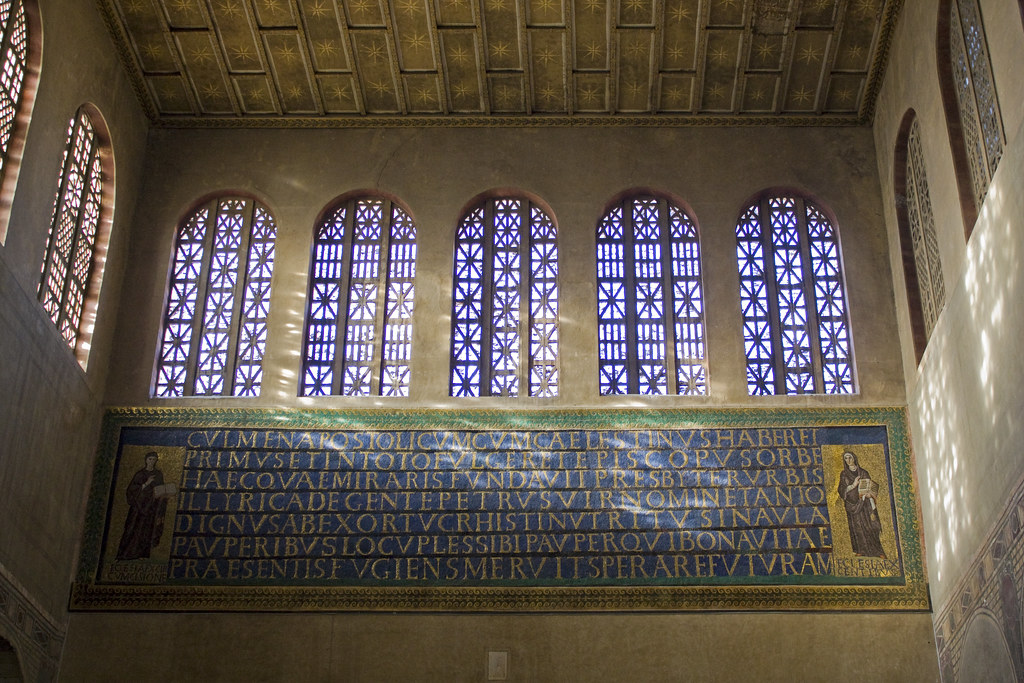
Interior of the Memorial Church of Moses, the few remaining original parts of which are Byzantine in origin, and which now houses mosaics from various parts of the 6th century.
I know next-to-nothing about the mosaics mounted on the walls, but I am guessing that they were probably preserved from the church built there in 597...
...which covered over these earlier ones from the church built there in around 531. Which is how the earlier mosaics are in near-perfect condition. The one on the floor here is a hunting and herding scene featuring various African animals. At the far end is a baptistry, also dating to 531. (They know that 'cause it's signed with the names of three of its masons and of the bishop at the time.)
Another amazing panel on the wall. I like the Islamic-style patterns in this one.
Detail of this amazing ribbon border that we'd see in many other places. (FYI, in these mosaics, there are 13 different colors of stone, all naturally-occurring.)
Our next stop was in Madaba, famed for its own mosaics, and, apparently, the next place on the king's itinerary as well. There was a large-ish police presence in town, and lots of men milling about in the huge roundabout in the center, but sadly, no king sightings for us. There was, however, an insane number of mosaics!
Entering the Madaba Archaeological Park. No idea whether those festive little flags are always there, or were part of the decorations for the king.
Mosaics from Ma'in, which is about 30 km southwest of Madaba. These date to about 719 AD, but the buildings in them look astonishingly modern. (As in, I feel like they wouldn't be out of place in modern Amsterdam.)
The buildings in the mosaic formed a border showing important cities and constructions in the area at the time.
Inside the Church of the Virgin Mary, with the first mosaic floor discovered in Madaba in 1887. Bear with me here: this Byzantine church (ca. early 7th century) was built on top of a 6th-century mansion, now known as the Hippolytus Hall, which was, itself, built on top of a Roman temple. The shape of that original temple influenced the round shape of both the church nave and this mosaic--most of which actually dates to the 8th century, as the original mosaic here was repaired with newer, Islamic-influenced designs. Gahhhhhh, so much history in one floor...!
Detail of the mosaics remaining from the Hippolytus Hall, 500-550 AD. I was going to take a better photo of these, but then got distracted by a man with a spray bottle. (More about him in a minute.) But behold: a mer-cow and mer-panther! So...awesome...
This particular mosaic appears in the exterior entrance to the Hall, and those items in the center are sandals. As in, "No shoes inside, people; leave those sandals here." Love it.
The man with the spray bottle, who turned out to be a rather knowledgeable guide-type person, began spritzing the mosaics with water, and holy smokes. Suddenly the details and colors were alive. (Tragically, some jerk-face from later times built a wall bisecting this floor, because, you know, residential space was at a premium and mosaics were just so commonplace. UGH.)
More cities in mosaic: three versions of the goddess Tyche, with varying clothing and accoutrement, represent the cities of Rome, (the somewhat mysterious) Gregoria, and Madaba itself (far right).
Roman street that once sliced all the way through the city, complete with slight bow in the middle so that all runoff would drain to the sides. Those Romans, so clever!
The Church of St. Elijah was closed for mosaic restoration work, but we did get to take a peek into its crypt, built in around 595 AD, where one finds Madaba's version of the Tree of Life.
Back outside, some rather extraordinary mosaics brought here from a 6th-century site in Massuh, about 10 km north of Madaba, for preservation.
Oldest mosaic in Jordan, found on the site of the fortress of Machaerus, which was built by Herod the Great in the first century BC.
This was sad and kinda hilarious all at the same time: Jordan had its own wave of Christian iconoclasm in the 8th century, and many mosaics and carved items (but not all, thankfully!) featuring animals and people were quite literally defaced. On occasion, however, the destructors tried to make things still look pretty by patching up the destroyed bits; hence, this weirdly misplaced tree with legs and a tail.
After traipsing through the Burnt Palace (also with some mosaics), we found ourselves in the Martyrs' Church, which had, I think, the largest (if not terribly intact) mosaic floor I've ever seen. Kinda wish that guy with the spray bottle had followed us here with some sort of giant spritzing water cannon.
The sheer variety in the patterns on the floor here was unbelievable. None of the designs between those columns were the same, and there were various types of animals all over the place. For example, CHICKENS!
A camel!
Next, we went to see the oldest known map of Palestine and the Holy Land, which happens to be a floor mosaic dating to sometime between 542 and 570 AD. (It's part of the floor of the 19th-century Greek Orthodox St. George's Church, which was built on top of the ruins of an earlier Byzantine church. The circle just above and to the left of the center is Jerusalem, and the large body of water above it is the Dead Sea, with the Jordan river flowing out of it.)
Here's the other half of it, more-or-less. That's the Nile delta at the far right.
Since we knew the pickings around our hotel at the Dead Sea were slim, we decided to have an obscenely large lunch at
Haret Jdoudna, a restaurant in Madaba set in this gorgeous little stone courtyard and serving classic Jordanian food. We ate some muhammara (a Syrian red pepper dip that usually has walnuts, bread crumbs, olive oil, and, in this case, pomegranate molasses), shankleesh (dried, herbed cheese chopped with onions, tomatoes, and peppers), chicken fatteh (lemony chicken layered with rice, fried flatbread pieces, yogurt, and pine nuts); eggplant fatteh (HOLY CRAP SO GOOD! - roasted eggplant layered with fried flatbread, tomatoes and tomato sauce, tahini sauce, and pine nuts, topped with 4 miniature dried eggplants stuffed with walnuts and dried tomatoes!), hummus (but of course), fried halloumi cheese, and plenty of flatbread to go with everything.

Then traipsed across town to work off a little of lunch, and went to see the Church of the Apostles' massive mosaic floor, created in 578 AD.
Look at all the birdies, and the way their tails form little borders!
I have to say, I don't think the Byzantine mosaicists had nearly the skill of the Romans (
for example) when it came to faces--these all look rather simplistic and cartoony--but look how tiny the pieces are
in said faces. Those are like an eighth the size of my pinky fingernail,
tops. (Sweet parrot, though.)
Caught an amazing desert sunset on our way back to the hotel, where we actually skipped dinner (the horror!) 'cause we'd eaten so much at lunch.
The next morning, woke up to perfectly clear weather and took a dip in the Dead Sea, which I think may have been the most surprisingly enjoyable thing we did in Jordan. The Dead Sea is around 33% salt, which means it has this weird, almost viscous (but obviously still watery) texture to it, and swirly, oil-like patterns on the surface. It also means that you can't help but float like crazy in it (although it's impossible to swim, since your legs won't sink). It's utterly bizarre, and it made me laugh like an insane person (which wasn't so bad, since we were two of about six people on the beach at the time). Even at 8:30 in the morning, in late November, the water was pleasantly warm and the air was warm enough that we were entirely comfortable just bobbing about for a while. I genuinely dislike swimming and being in any body of water, really, but I could happily have spent all day in the Dead Sea. What a unique and unexpectedly lovely experience.*

Looking across the Dead Sea to the West Bank from our hotel, just after our swim. It was only this clear there in the mornings; in the afternoon, it got very hazy.
Because it was basically around the corner, we decided to pay a visit to Bethany Beyond the Jordan, the supposed site of Jesus' baptism in the Jordan River. I say "supposed" because the bulk of the evidence supporting this claim dates to at least 400 years after the event itself, and any good historian knows that facts have a tendency to shift over time, so I'm dubious. It was an interesting place to visit, though!
The cross-shaped pool in the foreground is the baptism site, and the covered areas are remnants of ancient churches built here.
Dueling baptism sites on the Jordan itself. The red floaties, on the near side, are Jordanian, while the yellow ones on the far side belong to Israel. (Mike and I wondered what would happen if you just jumped in and swam across. Really, it'd take all of 30 seconds. International incident? Swarm of armed men?? Would you be turned away and have to swim back?? So curious.)
All three of the most recent Popes visited the baptism site, and someone had the good sense to commemorate one such event in mosaic. (I believe that's also the king and queen of Jordan.) Because what else would one do on such an occasion, in this mosaic-rich part of the world? (I have to confess, I have no idea which Pope this is. John Paul II, maybe?)
After we left Bethany (which took longer than expected, because you can only visit on a guided tour), we headed north towards Amman to check out some of the desert castles. This one's Kharana (or any one of about 8 different spellings), which dates back to at least 710 AD (although is probably older). Its function has not been established, but it may have been an inn.
We'd heard it described as a big, empty shell, but really, those people were just not paying attention.
Look at these shapes and details!
Mike even spotted some rosettes, way up high!
Gigantic coffered ceiling, in one room only!
Beautiful plaster leaves over the front door! (Honestly, open your eyes, people. This place is amazing, and the man taking tickets that day was extraordinarily nice. He offered us tea, and we sat and talked with him for a bit, then chatted as best we could with a group of rather effusive, but non-English-speaking police officers who were taking a break from making their [I assume rather boring] desert rounds that day. Naturally, everyone asks about Trump, whether they speak English or not, so we taught them the word "terrible," and they immediately began calling Trump a "terrible dog." It was amazing.)
Next stop, Quseir Amra, built by a prince sometime in the early 8th century, probably as a desert retreat. Not so much of a castle, really...
...but utterly and astoundingly frescoed on the inside. Frescoes. In the desert. What? How??
Massive mural in the audience hall.
Ceiling in the entrance/warm room in the little bath complex.
Dome in the caldarium (hot room of the baths) painted with constellations of the northern hemisphere and the signs of the zodiac.
Sadly, as everything in Jordan seems to close at sunset (~4:00) in the wintertime, we just missed out on visiting Qasr al-Azraq, the 13th-century fortress ruin used as a base by Lawrence of Arabia during 1917 and 1918.
Booooo. A wee bit of consolation was taken in having dinner at
Fakhr-el Din, this fantastical upscale, but old school, restaurant full of fancy people and waiters in fezzes. (Well, at least a couple of them, one of whom--handlebar-mustachioed himself--
loved Mike's facial hair. Which seems to be popular no matter
where we go.) We shared plates of pastrami; ful; arayes (little crispy meat pies); hummus topped with chopped beef and pine nuts; mujadara (seasoned rice with lentils and fried onions); fattoush (NEW FAVORITE SALAD EVER made with purslane, lettuce, fried pita pieces, sumac, mint, cucumber, tomatoes, olive oil, and lemon juice); plenty of fresh, hot bread; and a bottle of Jordanian merlot from the St. George winery. There wasn't a dessert option; instead, they brought a massive, pedestaled bowl of fruit and a few dishes of candied fruits in syrup to the table.
Extravagant.
The next day we got up and headed straight to Jerash, which I've seen described in several places as "the best preserved provincial Roman city in the world." Can't say I disagree.
On the way, passed so many roadside veggie stands (most of which were located on the shoulders of highway on-ramps, yikes). This time there were eggplants as far as the eye could see.
And then Jerash! The huge and astounding Hadrian's Arch, built in 129/130 AD in honor of the emperor's visit to the city.
Acanthus leaf carvings. Never seen anything like these before!
Mosaic floor of the Byzantine Marianos church, built in about 570 AD.
The Oval Plaza, built around 110 AD.
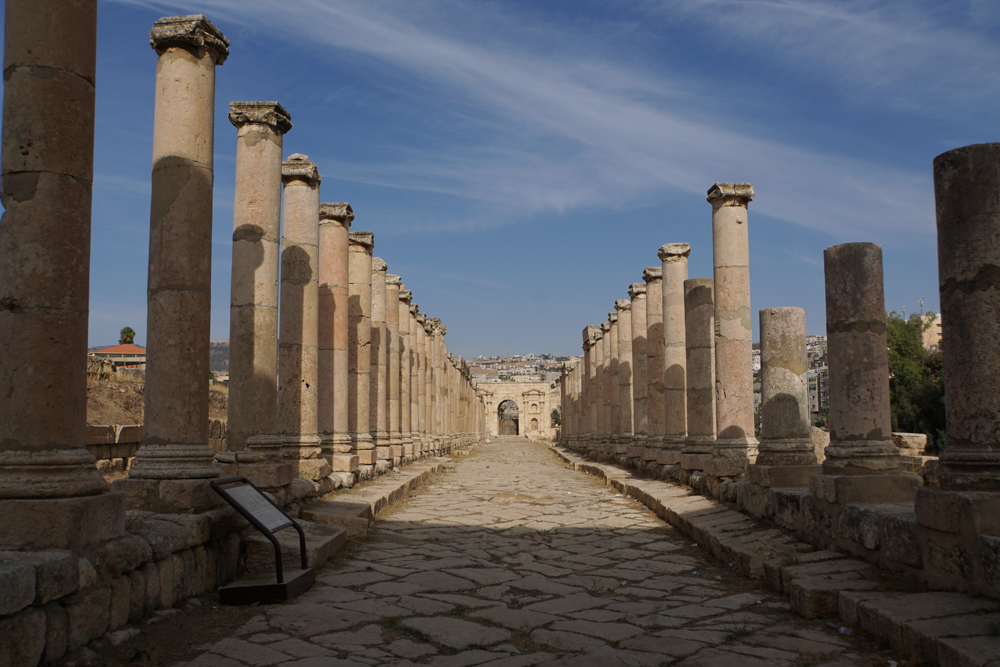
Columns along the cardo (main street), originally built during the 2nd century and rebuilt during the Byzantine era (5th and 6th centuries). This 800-meter-long street was originally entirely lined with columns.
Chariot ruts on the paving stones along the cardo!
The macellum (food market), also built in the 2nd century, with Greek cross-shaped fountain at the center...
...and some huge stone table legs with animals carved into them. (It is surmised that these probably belonged to a butcher's table.)
The massive nymphaeum (public fountain) from around 190 AD, built to create a main water source for the city center.
In the foreground, pink granite columns from Egypt!
Heading towards the north gate of the city along the north cardo (the columns here are much shorter and simpler than those to the south), built in 115 AD.
North theater, built in 130 AD as a meeting place for the municipal council.
Some of the seats have carvings allocating them to specific representatives of the city's 12 civic tribes.
Carved corners at the bases of the walls adjoining the seats!
Amazing remnants of the mosaic floor in the church of Bishop Isaiah, built around 560 AD.
Gorgeous details!
The Temple of Artemis, built in 135 AD, but never completed...
...as only 12 of the planned 32 enormous columns were installed.
More unbelievably intricate mosaic floors in the church of Saints Cosmas and Damianus, built around 530 AD.
It amazes me that A) these floors are just left open to the elements, and B) there's still so many of them.
The larger (and older) south theater, built between 80 and 96 AD.
Despite damage from an earthquake in 749 AD, and the "repurposing" of some of the stones from the scenae frons (stage backdrop) for housing by local villagers in the 19th century, the theater is in remarkable shape and is now used for concerts!
Oval Plaza from the Temple of Zeus.
Lots of beautifully-carved rubble in Jerash.
One more last view of Hadrian's Arch on the way out. Magnificent.
Had time after Jerash to dash over to Ajlun castle, an unconquered anti-crusader castle built in 1184 AD by Saladin, then partially demolished and rebuilt in the next 100-ish years.
There's not so much to see inside, but the place is in a remarkable state of preservation.
Lots of gorgeous vaulting.
There's also a little museum full of artifacts found in the area.
Cornucopia carving in the wall, probably a block reused from a nearby Roman temple.
Ancient basin for ablutions.
View from the castle roof. Definitely would give one an excellent view of any approaching crusader armies.
Ajlun on the hilltop to the left; this one's at 1123 m (about 3700 feet) above sea level. Spectacular.
We made our way back into Amman, past so many of those tiny roadside coffee stands--all of which turn on their various strings of Christmas-style lights and flashing beacons after sunset--and through the crowded, death-defying traffic back to our fancy-schmance hotel...
The Amman Rotana, which, we learned, had just opened the week prior to our visit!
...and then to dinner at the rather casual and utterly fantastic
Levant (where we were, once again, the only obvious non-locals). We shared some eatch (bulgur with tomatoes, onions, red chile, red pepper, and parsley); Armenian hummus with red pepper puree; freekeh (young wheat) baked with cheese (HOLY WOW, SO GOOD); eggplant rolls with meat, cheese, and tomato-eggplant sauce; overnight-marinated chicken, grilled and topped with cheese; and for dessert (for once!) kunafeh, a cheese pastry soaked in sugar syrup and topped with a crust made of very thin, sweetened noodles, and--here--served over its own little fondue-style flame. (We'd tried this before in Turkey, where it was tasty, but this one was jaw-droppingly good.)
The next morning--our final full day in Jordan--I convinced Mike to go to the Jordan Museum, an exceptional collection of just some of the country's astounding archaeological artifacts. A tiny sampling of the jillions of photos I took there:
They don't play around at the Jordan Museum: right away, they hit you with the world's oldest large-scale statues, unearthed in the 1980s at the Ayn Ghazal site just outside of Jordan, and created between 7700 and 7500 BC. (I couldn't help but see Tim Burton characters in those faces...)
Rocks incised with animal figures, between 6900 and 6500 AD.
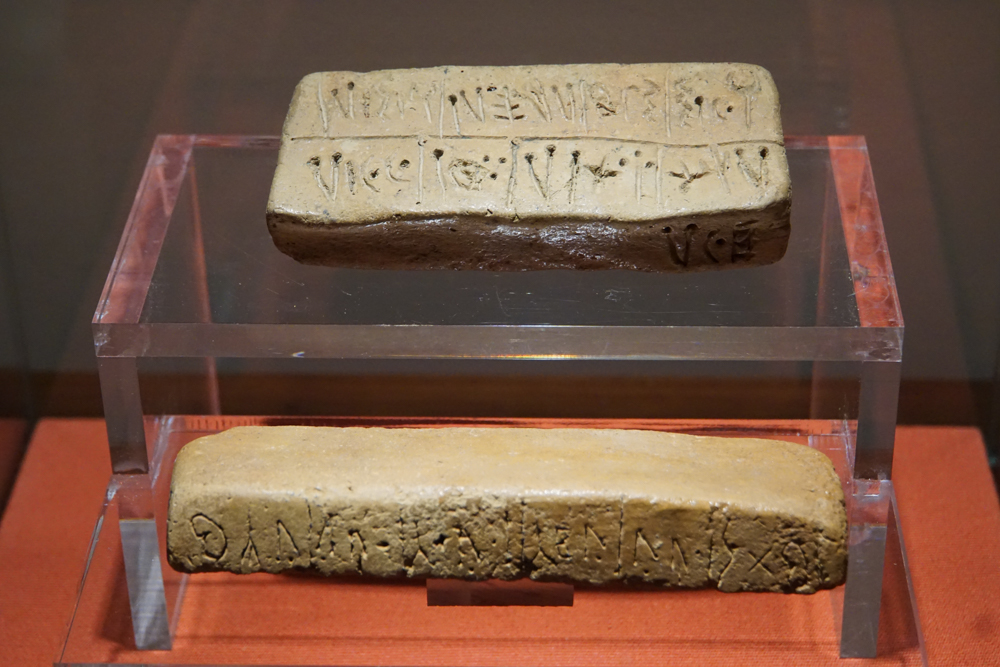
A couple of blocks inscribed with "mysterious writing" that has yet to be deciphered, probably read from left to right, dating before 1200 BC.
Nabataean pottery! From the 2nd century AD, with a very typically Nabataean design.
And the final show-stopper, some fragments of the Dead Sea Scrolls.
The Copper Scroll, from the 1st century AD.
Next, we headed up to the Amman Citadel, upon on top of an 850-m-high hill that's been occupied for around 7000 years. (Also, it's got city views, and also, that flag is huge.)
Umayyad palace, from about 730 AD.
Some really gorgeous carvings inside (apparently) showing Persian influence. I know nothing of that; I just know they're really, really pretty.
Rather a lot of carved rubble lying about up there.
Some of those Nabataean crow-step patterns, like at Petra!
Ducked into the little on-site museum, where we found a small, but amazing, collection. Here, some tiny pots from Petra.
Pot with absolutely amazing detail from the 7th century BC, found not far from Jericho.
Soapstone cooking pot from the 8th century AD, found in the northwest near the border with Syria.
Ruins of the temple of Hercules, from about 160 AD.
View over the Roman amphitheater from the Citadel...
This amphitheater was built in the 2nd century AD and restored (a bit inaccurately, in places) in the 1950s. It seats around 6000 people, and is occasionally used for concerts during the summer.
Out front is a tremendously long Greek inscription, about which I can find zero information. It's pretty impressive, though, and I love the variations in the script size, like someone forgot a few letters and added them in later. Heh.
Ducked into the little "Jordan Museum of Popular Traditions" on-site, where they had some incredible Jordanian and Palestinian costumes on display. Here, some silver headpieces with Syrian repousse, worn by Druze women. (We also visited the Folklore Museum there, but they were much stricter with the "no photos" rule.)
Headdresses from southern Palestine.
Stunning embroidery.
Room full of small mosaic panels from all over the place, built into the tunnels in the amphitheater.
Back outside, we checked out the Odeion, the tiny, 500-seat amphitheater next door to the main one.
With that, it was time to head to our next destination: a cooking class at the absolutely charming
Beit Sitti, in the lovely Weibdeh neighborhood of Amman. We chopped about a jillion cucumbers, handfuls of parsley, and mint for a terrific tabbouleh, and for a yogurt/cucumber/mint/garlic dish; we stuffed some filo dough with a mixture of beef, lamb, rice, peas, carrots, and onions, in order to make meat pies called
ouzi; and finished with
basbousa, a coconut cake with a bit of tahini, for dessert. It was all extraordinarily delicious, and the group of locals cooking alongside us (as an outing for a birthday) was wonderfully friendly. At the end, two of them even invited us out for coffee and gave us a ride back to our hotel--yet
more proof that the Jordanians are a fantastically warm and gracious people! (Speaking of which, many, many thanks to our friends Ammar and Lina for their recommendations in Amman! We ate tremendously well, and are excited to go back and really explore all that the city has to offer, since we didn't get spend
nearly enough time there.)
The next day, we got up and had breakfast at the hotel (pricey, sure, but you should have seen that spread [including galayet bandora, or stewed, seasoned tomatoes, which I'd been keeping an eye out for]) and drove through downtown before heading to the airport.
Man, I'd love to explore downtown, with its markets and shops and pretty, pretty things, and I hear tales of the glory of its street food... Sigh. Next time.
And with that, we headed back to the airport and made our way home, out of the 28-degree weather and back into the "it's a high of 2 today!" wintriness of Zürich. (That's 82 and 35 Fahrenheit, Americans. I'm just trying to get along here, ok?) I knew a warm birthday would be a good thing, and I wasn't wrong. Mike for the win!
A safe and joyous holiday season to you all, my friends. I'll see you in the new year.
*Super interesting fact: what they don't really tell you about swimming in the Dead Sea--ok, there was a tiny sign on our beach warning us not to put our heads underwater--is that it's actually quite dangerous. If you swallow or inhale any water, it's saline and full enough of other minerals that it can burn your insides, basically causing chemical pneumonia, and caustic enough to burn your eyes if you get any water in them. Moral of the story: only float on your back, and do NOT put your head under. (I couldn't help but taste the tiniest drop of it, though, and it was awful.)