Showing posts with label TV. Show all posts

Tuesday, October 13, 2015

Juliette is the sky, and i am the sun. (or, Verona part 2.)

Ah yes, where were we?

Lovely, lovely Verona, Day 3. Breakfast at Flego, of course, and then we took a long and muggy walk outside the center, past this ol' castle...

...called Castelvecchio (which actually means "old castle" in Italian, heh)...

...to the church of San Zeno. Yes, ok, I know, I'm obsessed with visiting old churches, but they're so pretty! And full of art and fantastical architecture! And packed to the gills with history--a combination which, as we all know, I simply cannot resist!

Just look at it. Gorgeous and so old. Most of it dates to the 12th century, of course, as that pesky earthquake caused quite a bit of damage here, as well. (Interesting tidbit: that rose window is called the "Wheel of Fortune." I kid you not.)

Detail of that amazing polychrome over the porch entrance (1138).

The ship's-keel ceiling and current wall height were achieved in the late 14th century. Interestingly enough, the crypt here is open to the main sanctuary, and you can see its entrance above, in the center  of the nave (it's those three dark arches, which are over the staircase leading down to it). 

Behind the main facade are these massive bronze doors, which were assembled from other doors made by several unknown artists over (mainly) the 12th century.

Wall of frescoes dating back to the 12th through 14th centuries. In several places, you can see pieces of even older frescoes showing through.

Down in the crypt, which took its present form during the 12th and 13th centuries, when the original 10th-century crypt was "rearranged". (Sounds complicated, considering this is underneath the main church.) The remains of Saint Zeno, 8th bishop of Verona, are down here. (He died in about 380 AD.)*

On our way back into the center, we passed Castelvecchio again. (Next time, we'll visit its museum; not only is the place a medieval castle--built by the Scala family, of course--but it's rumored to be positively packed with ancient paintings and sculptures, as well as jewels and arms. Yes, please.)

Immediately next door is the Gavi arch, a bit of 1st-century Roman architecture whose history is far more interesting than its actual structure. It was destroyed under orders from Napoleon--the French found that it blocked traffic, and dumped its pieces at the Roman amphitheater--and rebuilt next to the Castelvecchio under orders from Mussolini, in a bid to bolster the legitimacy of the Fascist government by invoking the traditions and might of the Roman empire. 

Castelvecchio and the Gavi arch just happen to lie at one end of the action-packed Corso Cavour, which is lined with palaces (such as the one above) and ends at the Borsari gate (which you may recall from such posts as this one).

Passing back by the amphitheater, we got to see the set-swapping crane in action. We were hoping to see it pick up something amazing, like the gigantic arm above, but no such luck. Boooooo.

Passed this gem of a building, too. Don't kid yourself: Verona is loaded with absolutely marvelous architecture. 

 I'd had zero plans to make this almost entirely a church-visiting trip, but we'd purchased a combo ticket that first day, and so what are you going to do? Our final stop was the church of San Fermo, and holy cow, what a way to finish things off. The current form of the church was created between 1261 and 1350.

Just check out the shape of that ceiling. Incredible. 

If you take a slightly closer look, you can see the zillions of little arches up there...

...all of which have someone's face in them. Apparently, there are 416 saints painted on this ceiling.

Nifty model of the construction of said fantastical ceiling.

The main sanctuary was quite beautiful, and rather unusual, I thought.

Check out this amazing red marble Gothic pulpit from 1396...

...and these incredible 14th-century frescoes over the main altar!
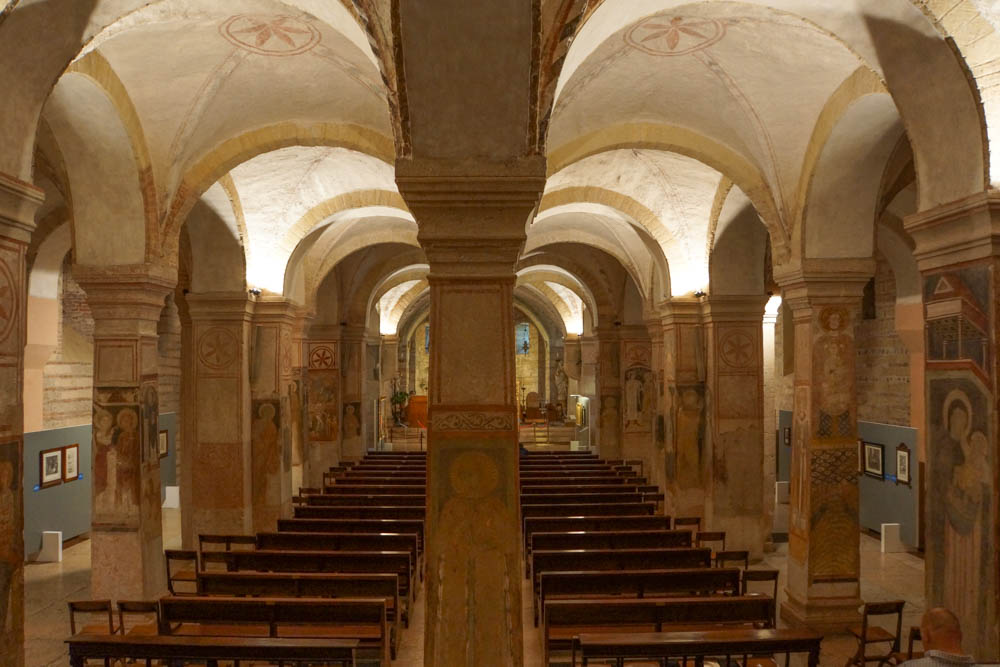
And then we found the lower church. Which looks like this, and was built between 1065 and 1143. (Yes, I know, there are manmade things in existence that are considerably older than this, but still. THIS IS OLD. And in spectacular shape.)

The lower church is absolutely covered in frescoes from the 12th through 16th centuries. Those six-petaled flowers on the ceiling were painted by the Benedictines during construction in the 12th century, but the patterns were only rediscovered in 2005.

There are sixty-eight frescoes, to be precise, although some of them have been lost due to the recurrent flooding of the Adige river.**

Perhaps even more remarkable is that some pieces of the original paleo-Christian church--that is, the one built here in the 5th or 6th century--still survive in the Benedictine lower church. At least, that's what all of the signage said...but I have no idea to what they were referring. I'll just assume they were correct, and that I was unobservant. Yaaaaaay for ancient history!!

Ahem. Post-San Fermo, we stopped for a snack in it shadow, at the welcoming little Bar Fermo. (I ate the healthiest thing I've ever had in Italy there--this crazy-but-delicious concoction of 5 different grains, 4 types of beans, and 3 types of seeds, topped with grana padano and a little tuna. Stop for a bite, if you're in the neighborhood.) Then, as we were essentially done for the day and ready for a little AC***, we made our way back to the hotel.

But first, we made a point to wander past Porta Leona, a remnant of a Roman city gate built and refurbished between about 50 BC and 70 AD (and a counterpart to Porta Borsari).

Foundation of original lookout tower next to Porta Leona.

Just around the corner from our hotel, we ducked into this intriguing little wine store which had caught Mike's attention from the very first. The proprietor, Oreste, an incredibly outgoing and quite elderly Italian man who spoke zero English, gave us a tremendous welcome and kept pouring samples of Prosecco for us. Oreste is quite proud of the fact that his place is mentioned in the Rick Steves travel guides, and has photos of himself with Mr. Steves to prove it.****)

In retrospect, I absolutely and unequivocally should have bought this sweatshirt.

After cooling down for an hour or two (yes, we watched some TV off of Mike's laptop in our room that afternoon, and I'm not ashamed because it was so ridiculously hot), we headed off to Osteria il Bertoldo for a little dinner. What a cozy, quiet little place, tucked away from all the tourist noise...and what food. Their specialty is seafood, which seems a little strange in landlocked Verona, but when you think about it, in Italy, you're never more than a few hours' drive from the sea. Obviously, then, I had to start with their antipasto plate of lemony octopus salad, anchovies baked with bread crumbs, and whole salt-and-pepper shrimp, with three wee little herby hush puppy-type croquettes; and Mike went for a ridiculously tasty white bean, sausage, and clam soup. Next, I had a plate of chopped eggplant with smoked mozzarella and tiny datterini tomatoes with basil, all served up in a bowl made of crispy Parmigiano (yesssssss), and Mike had a baked risotto with sausage, smoked mozzarella, and zucchini. We split a plate of grilled fassone veal sliced onto a pile of baby arugula with more datterini and Parmigiano on top, and then it was onto dessert: the delizia al limone, which turned out to be a limoncello-soaked cake topped with limoncello custard, then with a heavy lemon-infused cream, and finally, with unsweetened whipped cream on top. (Um. Just writing this makes me want to go back, right now.)

After dinner, we roamed the streets for a bit...


...and then called it a night. Caught our last breakfast at Flego (sigh...), complete with one final round of mini-pastries:


...and then pointed our rental car north, towards home. As usual, what should have been a five-hour drive was more like seven, given tunnel traffic and abundant construction zones, but at least the scenery was beautiful. 

And castle-y.

Two thumbs way, way up, Verona. We loved you and we'll be back.

What we're watching: How to Get Away with Murder, and holy crap. I think this is one of the few shows on TV that's not entirely predictable, which I love about it. Fair warning, there's a good bit of skin--and, obviously, murder--on it, but it's riveting. And we've started in on The Good Wife, which is ridiculously, ridiculously compelling. There are some good shows out there right now, people! It's refreshing. Also been indulging in a bit of rugby, as the World Cup is being played right now in England. I know their chances aren't great, seeing how strong Australia and New Zealand are, but hey...they're my people, so GO, SCOTLAND!!

Next up: a good bit of cheese, and the cows come home. (Again.) Which two things, oddly enough, are in no way related--at least, for our purposes here. See you next time.


*Crazily enough, in 2012, to commemorate the 1650th anniversary of Saint Zeno's ordination (as if that's not an arbitrary number!), the local bishop had Saint Zeno's body disinterred for some rather extensive study, research, and stabilization, and then took him on a tour just about everywhere throughout the province and city of Verona in a glass coffin. In October 2013, the body and relics were even visited by the Pope.

**And just in case you're wondering, yes, it is possible for me to get ancient-church fatigue, in a similar manner to that in which I get museumed out: after a point, one has seen perhaps too much amazing art and architecture within a small amount of time, and ceases to be properly moved by it. Not to worry, though: the recovery period is usually very, very short. (On to the next!)

***That's "air conditioning," for my European readers. I know, I know, it's sehr American, but you, too, might enjoy it when it's 40 degrees and 80 percent humidity outside.

****Upon revisiting his website today, it appears as though Oreste has retired since we were there, and is putting his shop up for sale. I feel genuinely fortunate to have stumbled in there on a whim--what a wonderful experience we had with him! (And yes, we did come home with some wine. How could you doubt?)

Sunday, July 20, 2014

nobody expected the Spanish Inquisition.

Or another blog post so soon, amirite?? It's only 'cause that last post was getting out of hand, length-wise, and now I'd like to finish it, since I have the tiniest bit of momentum going that direction. Yay, ambition!

So. Because we'd gotten through my (in retrospect, woefully deficient) list of must-sees in Metz in two days, we decided to hop on the ol' motorcycle and head ever so slightly north to Luxembourg, because I didn't feel like we'd quite done it justice the first time around. (It'd also been a REALLY stressful trip, what with Ned's steadfast refusal to take his epilepsy pills for our poor cat sitter.) Stop me if you've heard this one before, but Luxembourg City is another that has ancient roots, and is absolutely littered with tunnels, fortifications (its nickname was at one time "The Gibraltar of the North"), old towers, and other things that float my history-nerd boat, and I was quite excited to go back. (Not sure how Mike felt about it, but I think he was happy to be out and about on the bike, regardless of where we ended up. He's such a good sport.) Our first stop was the Bock casemates, which we'd missed the first time around.

These things were built in 1745 by the Austrians, one of eight (!) countries that have held Luxembourg over the centuries. To get down here you walk through what they're calling the "archaeological crypt," which is actually the excavated foundations of the first recorded fortress built here in the 10th century. (It wasn't terribly exciting, and I didn't take pictures. But please enjoy this one above, which is, I believe, part of the dungeons from some fortress or other that was on the site. And, therefore, older than the Austrian fortifications. Duh, Sarah. Take a picture next time, why don't you.)

The view from the north side of the casemates through one of the cannon openings, which were blasted open to prevent them from being used again after the country's declaration of neutrality in 1867.* (The tower-y thing here is called the "Hollow Tooth," and is supposedly the last surviving remnant of the 963 fortress...or it's the last remaining piece of the ginormous towered gate structure that was part of the defenses on this promontory. No one seems terribly clear on this.) 

Detail from one of the cannons...love the bow. Very tough. (Just FYI, these particular casemates could, at their peak, accommodate 50 cannons and 1,200 soldiers.)**

Sooo many tunnels down here, some of which are up to 40 m underground. There were originally 23 km of casemate tunnels under Luxembourg City, but the accessible portions were reduced to 17 km in 1867. (They couldn't destroy them all, however, seeing as how a sizable portion of the city above would collapse.)

This part was super interesting: the slots carved at the back (and all over the place, in this section of the tunnels) were for mining the joint, in case it was compromised during battle and had to be destroyed.

View from the south side of the casemates, into the lower city. Somebody's got some lovely gardens down there.

You've seen this shot before, but I couldn't help but take this picture again: I think it's a spectacular view, since it shows both the 14th-century Wenceslas wall (the one that starts at the bottom, runs across the river, then turns left) and the 15th-century Jacob Tower (top left). Neat. (Plus, it's just so green this time around!)

Interestingly enough, our exit from the tunnels was through this bridge, which, I'm told, provides at least four, if not five, ways of crossing between cliffs: over the top, through the middle passage, via a spiral staircase inside, or through the tunnel underneath the road below (and I can't seem to find what the fifth is). Craziness.

After the casemates, we ducked into St. Michael's church (whose present exterior dates to 1688), wherein the most interesting things we saw were some modern stained glass telling the city's story (which was NEAT, and of which I was apparently too lazy to take a photo, yet again), and this interesting little archway with some sort of Latin quote painted on it backwards. Go figure.

Rode past the Three Towers Gate on our way into the Pétrusse Valley. The central tower dates (probably) to the 11th or 12th century, and the outer two to the 14th.

And here's why we were going into the valley: the Quirinus Chapel, which is a little 14th-century church carved into the cliff wall in the valley. (The roof and bell tower were added in the 19th.)

I love how it's tucked into the cliff wall, and that you can't see it from above...only from the valley floor, where you also get a view of the extremely modern buildings in the city above.

The place is gated, so you can't go inside, but you can see in. The interior's a bit dark and a lot creepy.

Next, it was off to the remains of Fort Niedergrünewald (built 1684-85), which you can see from the old city, and which I desperately wanted to explore the last time we were there. (There really are walls and bits of forts that beg to be explored [at least, for me they do! must see ALL the old stuff!] on every hillside.) 

View from Niedergrünewald into the upper city.

The Vauban towers (17th century) and 1859 railway entrance into the city from Niedergrünewald.

Sadly, we missed the main 17th-century fort that I'd wanted to visit, and only after we'd arrived in the city did we discover that there are not one, but two, well-marked historical city walks which explore (between them) the majority of the fortifications and ruins and generally awesome historical bits all over the city. Which means we'll have to go back. Obviously.***

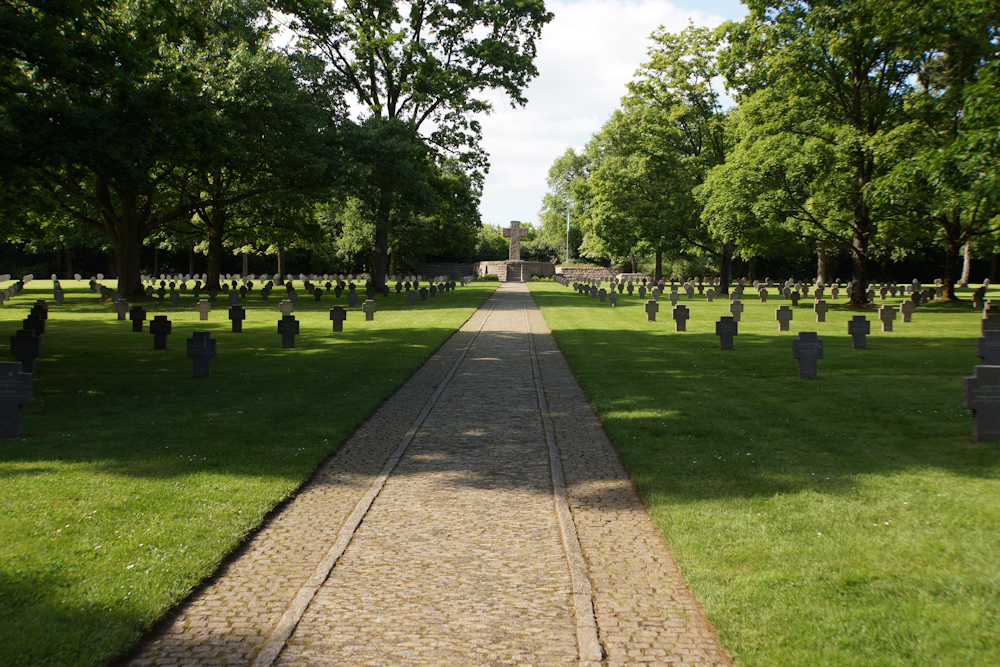
On our way back to Metz for the night, we decided to visit something a little different: the German military cemetery at Sandweiler, the counterpart to the American cemetery just a few kilometers away, which we visited the last time we were in the neighborhood. Both of the cemeteries serve as the primary burial ground for soldiers who fought in the Battle of the Bulge, but this one is far more understated than the American cemetery, which was full of grand maps and monuments and memorials. The giant cross at the end marks the communal grave in which unidentified remains are buried.

I found it almost as poignant as the American cemetery, since no matter which side of the war a soldier was on, and no matter what he believed, he was still someone's brother or husband or son or father. Someone missed him when he was gone.

Back in Metz, it turned out that every restaurant we'd found intriguing was full, so we ended up eating at one of the sidewalk tables in a fairly snooty place called Au Pampre d'Or. The view from our table may have had something to do with our decision to eat there...

Not too shabby. Didn't hurt that the weather was absolutely perfect, either.

Sadly, the service made this maybe the longest meal of our lives; the wait between courses--especially given what we paid for this meal--was almost interminable. At least the food was pretty great: Mike started with a foie gras salad with raspberries, mango, and red cabbage, and I went with a dried-tomato-dusted avocado garnished with tomato and olive oil. About a year later, Mike got to enjoy his rack of lamb with veggies and a corn-cream sauce, and my thinly-sliced beef over arugula with shaved parmesan and balsamic vinegar was stellar. Then we got to select some options from the cheese cart--yay!--and ended up sampling nine different varieties between the two of us;**** my favorites were a local cheese covered in cumin seeds, the goat cheese (of course), and a lovely Beaufort (which I've liked all three times I've tried it...so many cheeses in Europe...). Finally, finally, we received our desserts, which consisted of a molten chocolate cake with fruit for Mike, and a bowl of strawberry-basil puree with little meringue "islands" in it for me. (Er, guess who was the flavor winner there.) Our waitress was very sweet, but it was apparently the kitchen's inability to keep up that made an otherwise really good meal into an irritating and pricey (if still tasty) experience. At least I got to stare at the cathedral during sunset, I suppose. That wasn't entirely painful. 

After dinner it was back to the opera house bar for a nightcap, and there we discovered small ballroom full of enthusiastic--and fairly skilled--tango dancers. It was really charming to sit there for a bit, under their giant chandeliers, and to revel quietly in the romance of drinking our prosecco and watching tango dancers glide around a ballroom in a French opera house. Pretty surreal, actually.

It was back into the center the next morning for brunch at Au Marché (yup, again!), which was, in my opinion, a spectacular affair: the entire (not small) bar top was covered in quiches and wraps and pastries and breads and terrines and miniature pastries and pâtés and smoked salmon and gorgeous fruit tarts and juices and coffee and tea, and then, included in your cover charge, was an omelette (your choice of toppings) with salad and roasted potatoes. And the stuff on the bar was all-you-can-eat. Thank goodness we have nothing like that--at least, nothing even remotely affordable--in our own city. I ate so very, very much--have this horrible compulsion to sample everything! 

And with that, our time in Metz came to a close. It's such a lovely, charming, and cozy little city center... I highly recommend spending a few days there, if you're in the neighborhood. (On a side note, which I forgot to mention last time: that city is nothing if not user-friendly. It's extremely well-signed, and look what's on the pavement, to guide you to your 16th-century dragon effigy, or 13th-century tower bridge:

Graoully!

Hee. Love these.)

What we're watching: the World Cup, which has been basically irrelevant for most of our American lives! But was fun to get into, here in a part of the world where people are really passionate about it. (As in, even from our apartment in a fairly quiet neighborhood, several times we could hear shouting and cheering in the streets.) We watched the US team and the Swiss team make it out of the first rounds of play, then get well and truly beaten in the elimination round, but we kept watching. The semifinals were painful--Germany absolutely beat down Brazil, and the Argentina/Netherlands game was the most boring "sporting" event I've ever sat through--but the final was exciting, riveting, and yet still tied-at-zero-almost-the-whole-way-through, until just at the end. Good for you, Germany: you earned it. 

Also (still) watching our way through The West Wing, although we're closing in on the end of it, which makes me sad, because there were so few slow episodes. So many shows get in a good season or two, and then limp along until the network kills them off, or are truly brilliant and get prematurely axed, but this one really stayed consistently good. (Well, almost entirely...no one's writing is perfect, I suppose. But the cast on that show is, sheesh.)

Ooh, and also, we went and saw something new last week: the Alvin Ailey dance company was in town, and we finally went to check them out. (It's been on my list for several, several years now, and I finally bit the bullet and paid Zürich prices to get a good seat.) The first half-hour, 'Grace,' felt a bit one-note for me, although they did some really interesting things with the way the dancers interacted with the lighting, and had some really complex routines going on all over the place...and then the rest was incredible. The next piece was called 'Home,' and was really gorgeous and powerful, and had just about every imaginable style of dance in it, and then we saw the kind of solo I've only ever seen on TV, entitled 'In/Side.' It was just one guy on stage, and the way he can move and bend and control his body is just breathtaking, and so communicative. He was so fragile and exposed (both literally and figuratively, heh--nice shortie shorts!), but still so athletic and strong and sculpted (almost like a piece of art, himself), and it was tremendous. Really, really passionate and beautiful. The last piece, 'Revelations,' was also fantastic--lots of little pieces within one big story, and the best parts were the mostly-balletic pas de deux and this duet between two men set to Nina Simone's Sinnerman. Worth it, people, if you're into dance at all.

What I'm reading: yet another in a long, long string of first-person, female, autobiographical comedy writers. I seem to find them all in a rush, and then read tons. First there was Jen Lancaster, then Sloane Crosley, then, Sara Barron, but the best one I've read lately: The Potty Mouth at the Table, by Laurie Notaro, who makes me laugh out loud on occasion. Be forewarned, the title is accurate, but this lady is funny. I did take a break from female authors to read David Sedaris' latest, Let's Explore Diabetes with Owls, which I think I enjoyed far more than I would have, had we not heard him speak in Edinburg last summer. He's also hilarious, but there are tinges of tragedy around the edges of his stories, which I find far less distressing, for some reason, when I can imagine them in his actual voice. (The man is a genius with a written sentence, a talented storyteller, and hysterically funny in person, in case you're wondering.)

What we're eating: lots and lots of grilled things, lately, as we're not letting the weather slow us down on that particular front. (During the World Cup semifinals it was so cold outside we could see our respective breaths, and yesterday it was so hot outside I had all the shades drawn and our little R2D2 air conditioner unit huffing away in the corner.) And also, these brownies (although definitely not the gluten-free version, but isn't it nice that that exists?), and these cheesecake bars, which are definitely my favorite desserts for the summertime. Yaaaaaaay for when cherries and berries and stone fruits are in season!

OH YEAH...and if you haven't already seen this (or even if you have), you should. It's Ned wearing one of Mike's bowties. He did this by himself.

He looks like he's coming home late from some sort of a black-tie affair.

I love it so, so much. This cat rules.

Hmm...this feels like a weirdly short post, but that's probably for the best. Up next: a return trip to Chiavenna and environs for our anniversary. And Mike gets a new belt.


*Another interesting tidbit: it took them sixteen years to disable and/or destroy what they could of the functioning defenses in and around Luxembourg after 1867.

**The Luxembourg City Tourist Office has a lovely brochure for the casemates, which gives you essentially all of the information you could ever want to know about them. It's the main source here for most of the facts 'n figures. (The history major in me insists, on occasion, that I site my sources. I'm not going to lie to you: Wikipedia is usually one of them, although always I cross-reference to make sure I can confirm what they're selling me. HISTORY NERDS UNITE!!)

***I know I don't usually link to tourism offices, but honestly, Luxembourg has the best, and by far most helpful, city website I've ever seen (and believe you me, I do a lot of research before we go places). Decent (if a bit slow) online maps, lots of helpful informational things to download, and those brochures for the Vauban and Wenzel walks MAKE ME NEED TO GO BACK TO LUXEMBOURG AGAIN SO I CAN TAKE THEM. The walks, I mean. That's just good marketing, people, and besides, it's such a fascinating city anyway. (Did I tell you the natives all speak at least four languages?!)

****What?? They were small!