"Back so soon?"...you're probably wondering. Well, not
so soon: Mike's surprise birthday trip ended over a month ago and I'm just
now getting to it. And
that's only because I'm about to head out on another adventure in the near future, and so need to write all this down before new things push out the old!* Thus: to Germany! (As always, fair warning: this one's going to be
looooong, but I'll try to keep the wordiness to a minimum.)
Anyhoo. Thanks to the influence of 'Top Gear,' I decided to take Mike to the Nordschleife section of the Nürburgring for a little race drivin' in a fast car. And, because I had a week's time to fill, I decided to throw in a few castles and fancy restaurants as well. First stop: Nürburg and the racetrack.
Just so's you know, the Nordschleife is about 13 miles (22.8 km) long, has 73 turns, and is one of the most challenging race circuits in the world. Interestingly enough, it's classified as a public toll road, which means that anyone can drive any vehicle on it, and that you have to follow any posted speed limits, as well as the normal German rules of the road (...
go figure). It's also pretty darn dangerous for people who are idiotic and/or overly ambitious, as well, and so I was a bit apprehensive about turning my gearhead husband loose on the circuit nicknamed "The Green Hell." However, I also knew he'd
love it, and so off we went. We flew to Köln, rented a car and drove to the tiny town of Nürburg (itself situated entirely inside the race circuit); ate dinner at the
Pistenklause restaurant (as the only large-ish restaurant in the wee town of Nürburg, it's been the site of many an F1 victory celebration, and is also chock-full of some great [if rather kitschy] memorabilia!); and went to bed early so that we could be at the rental place first thing the next morning. (The track gets crazy-crowded by around 11:00 AM, and since you have to stop and pay tolls between each lap, the wait times can get to be over an hour...and that's
excluding the fairly regular wrecks and crashes which close the track until they're cleared off.)
People, I have never been to a more single-minded place in my life--the
only topic of conversation, the
only goal, the
only focus is the track! and driving it! there is
nothing else!--but it was quite a unique place, and everyone we met there was genuinely pleasant and friendly.
The afternoon we arrived, the Grand Prix section of the track was open (which was finished in 1984 to replace the overly-dangerous Nordschleife for professional racing**), and so absolute heaps of expensive and kitted-out cars were waiting in the paddock to get on the track. (It was quite something to see all of these just driving around the town, as well. It felt like we were the only people there who hadn't driven our own personal race car to the track.)
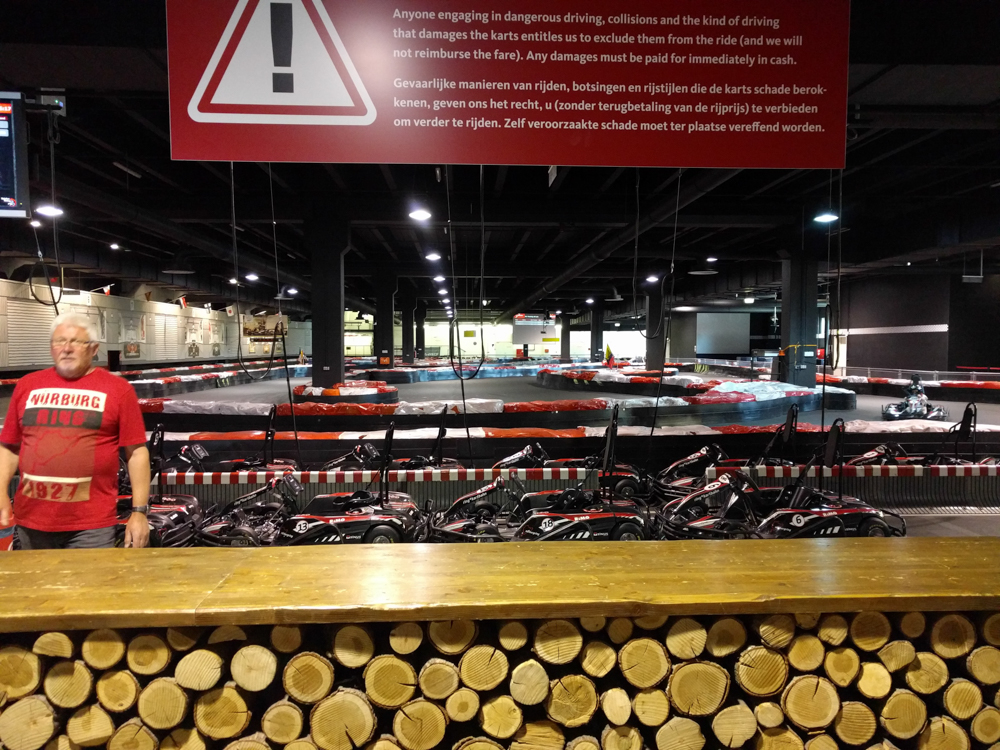
Mike and his BMW M3!
As I left Mike to his driving, I did take some comfort in that the "safety" briefing at the car rental, while touching on safety, mostly stressed just how expensive things could get,
very quickly, if one were to damage their car, another car, or the track in any way--a tactic which, I thought, was a GREAT way to trick overly aggressive drivers into being more cautious! (Game, set, match to the
car agency, which, by the way, was super easy to work with and full of really friendly people, in case you ever want to do this for yourself.) Post-briefing, I set off to explore the little castle ruin atop the hill while Mike got in his laps.
The walls were in pretty good shape, but there wasn't much inside, other than that tallest tower. Also, they don't really know exactly when this thing was built, but it's assumed that it dates to the 12th century (although much of the defensive wall, and the shorter towers, are 19th-century reconstructions).
Over the entry gate, the coat of arms of Johann von Nürburg from 1254.
View of our hotel, the viewing stands, and Grand Prix finish line from the top of the tower.
The rest of the 360-degree view from the top was of lovely, idyllic countryside, but don't kid yourself: from literally everywhere inside the town, and up on this hilltop as well, you could hear the cars and bikes on the track. It was madness.
This was at 9:00 in the morning on a regular open-to-the-public track day. I can't even imagine the racket when they're running an actual race!
Mike was able to finish his laps--both man and car intact and undamaged, yay!--by about 11:00 (including one that he rode with a professional driver, which I think was his favorite part of it all, but you'll have to ask him about that), and then we watched some motorcycle time-trials from the roof of our hotel, conveniently located at the Grand Prix finishing line.
This video does not do justice, in any way, to how fast these guys were actually going (or to how loud they were). There was motion blur without the camera!
And there were these crazy things, which looked like racing sidecars, except that the guy on the side was kneeling, so that he could tip back and forth to keep the whole thing stable on corners. Insanity.
And lastly, we hit up the trackside go-karts, which are supervised by this super nice man who's ridden his motorcycle throughout of most of the world, no exaggeration. (Allow me to potentially toot my own horn, at this point, if you will: only my husband can confirm whether this is true, but I genuinely hope that race car + go-karts = one of Mike's Best. Days. Ever.)
After a little souvenir shopping, we piled back into our (normal, non-race) car and headed east to Koblenz, a smallish city at the confluence of the Rhine and Moselle rivers, which is quite literally surrounded by castles (I'm not kidding, look it up), and has its own massive hilltop fortress. (Yesssssss.)
We dumped our stuff at the lovely and welcoming
Hotel Brenner and set out to explore the city a bit. Here, the absolutely gigantic Electors' Palace (
Kurfürstliche Schloss), built in the 18th century for the elector/Archbishop of Trier in the 19th century. Now, it contains several federal agencies, a chic little cafe, and lots of event spaces, but really the draw are the gardens and that enormous lawn. On the rather warm day that we arrived, people were picnicking and sunbathing and playing and whatnot, all over the place. It's a really gorgeous civic space, and one that made me want to flop down on a blanket with a sandwich and a good book.
Plus, those Koblenzers love their gardens. I've never seen comparable tulips, either in variety or in quantity, anywhere else.
Srsly! Look at those flowers! (I could post sooooo many more photos of various and sundry flowers here, but there's just too much more to cover. Schade.)
We also explored the old town a bit, complete with its weirdly famous spitting statue. (You can see the puddle it makes every three minutes or so.)
As in...he's so weirdly famous that he's on the local manhole cover. Go figure.
Nearby is the lovely Citykirche on the equally lovely Jesuitenplatz (center of old town, basically).
Back side of Liebfrauenkirche...
...and the inside. Built in the 12th century and completed (roughly) in the 15th, this thing was damaged in the late 17th century and rebuilt, then heavily damaged due to firebombing during WWII. The rebuilding afterwards lasted through 2007.
This place was nothing less than spectacular: the Romanesque basilica of St. Castor, which dates mainly to the 12th century (and is the oldest surviving church in Koblenz). Those towers are tall, kids.
Quick snap of the heavily-Romanesque interior.
Attached outside are some medieval walls lined with equally ancient gravestones...
...and these Gothic chapel ruins from about 1355...
...which surround this stunning garden with a pond and fountain.
The rear of the basilica ("
eeeeeee, look the apse!!", exclaims the old-church nerd...) backs up to the Rhine river...
...across which is Ehrenbreitstein fortress. Koblenz is scenic, folks.
About a minute's walk away is the Deutsches Eck, the corner of land where the Rhine and the Moselle meet up, and where there's the 37-m-tall (121 ft!) Kaiser Wilhelm monument.
People, there are a lot of bronze equestrian statues in Europe, but this one is mind-bogglingly huge and has what I consider to be a fairly interesting back story. Originally finished in 1897, this, too, was damaged during WWII bombing, and after nearly 50 years of redesign, debate, loss of funding, and controversy, a copy of the original was finally reinstalled in 1993. Detractors argued that the original design was far too martial and nationalistic (ahem) to be reconstructed, but the "new" monument was dedicated to national unity--it wasn't so long after the fall of the wall, after all--and international peace (and was financed by a private citizen, which made things easier...), and the matter laid to rest.
This inscription on the pedestal reads, "Never will the kingdom be destroyed, if you are united and faithful." So I guess that works, in the context of national unity.
This thing is also covered in, and surrounded by, all sorts of weird carvings. This particular one caught my eye: it's probably some sort of demon or goblin representing some sort of evil threatening the empire, but to my eyes, it's a vampire (found on the far lower left part of the front of the statue's pedestal, although I can find no mention or explanation of this figure anywhere). So: vampire it is.
Across the rather wide and sunny lawn behind the memorial are these obviously old, but sadly unlabeled, walls. After much research, I can possibly state that they're probably from the 13th or 14th century, complete with Teutonic knights' cross built into the stonework (to the left of the ivy, on that corner, and hardly visible here, as I didn't even notice it in person. I am no kind of history major at all.).
Dinner on that first night in Koblenz was at the sweet little
Mein Koblenz, quiet and tucked away in the old town, with tasty local food. As
sauerbraten is a local speciality, Mike opted to try it out, after we shared a plate of these crazy-good little dumplings topped with bacon, fried onions, prunes and plum sauce, brown gravy, and various little sprouts. I had some sort of cheesy, veggie-filled, puff pastry-involving thing, but I think I was far too focused on the dumplings and on Mike's plate to write it down (who saw
that coming?).
Good stuff, though
.
On day 2, we'd planned to head immediately to the Marksburg, a castle about 15 minutes south from Koblenz by car, but as we were parked in, we went instead to Ehrenbreitstein, which turned out to be way more interesting than I'd anticipated.
After riding the funicular across the Rhine from the city center, we arrived at the top of the fortress hill to find that our visit coincided with a once-yearly medieval festival. The costumes were elaborate and everywhere! (I didn't notice until after he'd passed us that guy's helmet has a long, long ponytail.)
Yup, that's a full suit of armor in 85-degree heat. (Ok, ok, 29 Celsius.) That's dedication, people.
Among many, many other things tucked away inside the fortress is quite a decent little museum on its history. Here, a French cannonball, rapier, and musket balls from the siege of the fortress during the French Revolution! (Man, those Revolters were all over this part of the world.)
The good thing about being at Ehrenbreitstein during a medieval festival: there's all manner of fascinating activities--metal forging! bow-and-arrow repair! all manner of smoked foods! jousting! music! and more! But there's also a down side: it's absolutely packed with people, making it rather difficult to get good shots of the fortress itself. At least with all the bystanders, you can get an idea of how massive this place is (and how tall its walls are!).
This perspective helps, too. So deep!
After WWII, with the shortage of residential housing, portions of the fortress were converted into apartments and were occupied into the 1960s. Here, the kitchen of one of those apartments.
Huuuuuuge, 9-ton cannon from 1524 (probably ceremonial, but still).
"Medieval" band o' pipers and a drummer. These guys were noisy, but pretty good (and totally unique).
And speaking of music, there was, of course, the requisite Celtic band, drawing a gigantic crowd. And no wonder: how fun are they?? I'd happily go to any party where these guys were playing.
View from the walls back into town.
After leaving the fortress (and drinking about a gallon of water), we found that our little car had been freed, and headed south to the Marksburg, the only intact and genuinely medieval castle (i.e., never conquered or destroyed) along the Rhine. As it can only be visited by tour, we made it with enough time to catch the afternoon tour in English. (Interestingly enough, our excellent tour guide actually lives inside the castle walls.)
Behold! Marksburg!
And now, a host of gratuitous castle photos. In this one, you can see the main entrance gate, which was ensmallened after they no longer needed a gate big enough for riders on horseback.
The keep, built in 1239 and made taller in 1468.
Ceiling of the 14th-century chapel.
The small armory contained a rather high percentage of utterly bizarre (and presumably only ceremonial) costumes. Then again, if I saw this guy on the battlefield, I'd be terrified.
Post-Marksburg, we headed back into town to drop off the car and clean up (listen, it had been a long and sweaty day, during which I got a magnificently vibrant sunburn, complete with camera-strap white lines), and then to find a cool drink along the river and work out where to go for dinner. We ended up at the marvelous
Deutscher Kaiser, sitting outside with a view of the Moselle (and all of its rather large cruise ships, the occupants of which were
in no way indistinguishable from the locals). I went a little lighter this time, opting for a starter of the asparagus risotto with shrimp and scallops (
holy wow!), and then a luscious bowl of leek soup with chickpea dumplings (also
wow). Hooray for spring veggies! (And also Mittelrhein white wine, of which we consumed a bottle here and there.)
The next day, we (sadly) said goodbye to Brunnen and its quiet, lovely little garden and tasty breakfast (I'm not sponsored, here--it's just the truth!) and headed towards Schloss Stolzenfels.
Stolzenfels, while a 19th-century rebuild of a medieval ruin, is pretty dang impressive. (Especially from the highway, which is where you have to park to get to it. Oh, sure, they claim they have parking, but it's really like 9 spaces in this near-inaccessible underground area.)
Those crazy Romantics, always rebuilding things the way they thought it should have looked. The original castle here was completed in about 1250, partially destroyed by the French in 1689, and rebuilt by the King of Prussia in the mid-19th century. (In fairness, there actually are a few remnants from the original buildings and 15th-century additions still in existence; the tallest tower, for example, is from the 13th century.)
Fun side note: this is another castle accessible only by tour; however, as we didn't want to wait all day on the chance that an English tour might come together, we elected to join a tour in German. And promptly understood about 90% of what was said to us, which was FREAKING EXHILARATING! (Although it didn't hurt that they also gave us a little booklet in English to fill in the gaps that we didn't quite catch the first time around.) Sadly, no photos were allowed indoors, but the exterior was fantastical, nonetheless.***
Interior courtyard with another shot of that medieval tower.
The arcade hall connecting the older part of the castle (on the left, Rhine side) with the 19th-century buildings on the right and with the pergola garden below.
The pergola garden, based on the original medieval layout: quite small, but really charming and with some spectacular flowers.
Next, we headed towards another rather famous castle that's been on my list for actual years: Burg Eltz, which has been in the hands of a single family for its entire 850-plus-year existence. For a place that was a bit inaccessible--you had to hike for 15 minutes to get there--it was positively crawling with tourists, and yet, it was so utterly spectacular that it was 100% worth the effort and crowds. Because look. (And also, two castles in one day!!!)
Holy. Smokes.
A few original bits of this castle date to 1157 (!), but really, the thing was under construction for 500 years.
Interior courtyard with all sorts of insanity.
I couldn't stop taking pictures here.
Burg Eltz gave us the opportunity take our second tour of the day in German, and this one was even more understandable: our guide spoke very slowly and clearly and simply (as one would speak with small children, which is really the
only way I can keep up with anything being said), and we understood
everything. (HOORAY FOR US AND OUR SUPER-BASIC GERMAN COMPREHENSION!
Ahem.) Once again, no photos allowed inside, but the
castle's website is quite extensive and has some really good stuff. (So many astounding works of art in the Lower Hall! Such amazing frescoes in the Upper Hall! Really, there were lots of incredible artifacts and interesting little touches in this place, plus tons of indoor bathrooms--which were considered the height of luxury at the time, but were really just small rooms jutting out over the side of the building with holes cut into the floor. But hey, indoors! [
Although look out below, suckers.]) In a nutshell, the place is utterly worth a visit if you're into castles, and as a bonus, you get to drive past roughly a jillion
other castles and old water towers and fancy Gothic chapels and wine-terraced hillsides and additional amazing things, no matter
how you get there! (It's fascinating countryside, no doubt.)
And on that note, dear friends, I'm going to leave the remainder of Mike's birthday trip for a second post, as there's a shocking amount still to come! And soon, I promise.
*I firmly believe this is the case in my brain. It's got quite a limited capacity, and explains why I can use German
relative pronouns--super useful, as it turns out, but one of the last new things I learned in A2!--with a decent amount of confidence, but can't for the life of me keep straight some of the noun genders for the most basic of words that I learned back in 2011.
Ugh.
**Seriously, if you haven't seen the movie '
Rush,' you should. It's about the rivalry between a couple of F1 drivers in the 1970s, and includes the 1976 crash that resulted in the closing of the Nordscheife as a professional circuit. It's actually a great movie, although it does have some rather gruesome bits as related to the crash.
***The one thing that's stuck with me from the interior--other than the intensely ornate wooden furniture--was a rather large and elaborate
model of the cathedral in Köln, made entirely of sugar. The thing was stunning, but it was far more important to a little boy on the tour to determine whether said model was edible. (Our guide said yes, theoretically, but that it was quite old and you probably wouldn't want to. Heh.)